
Before choosing protection, it helps to understand what paint correction actually does, how to maintain a ceramic coating, and why safe washing matters after any protection is applied.
What “ceramic” means in car care
In automotive appearance care, “ceramic” usually refers to protection products that use silicon-dioxide-style chemistry, ceramic resins, or ceramic-inspired polymers to improve water behaviour, gloss, slickness, and surface protection. The word is useful, but it is also heavily used in marketing.
A true ceramic coating, a spray sealant, a wash-and-wax, and a maintenance topper may all use ceramic language, but they are not the same service. The real question is how the product bonds, how the surface was prepared, how long it can realistically last, and what maintenance it requires.
What a true ceramic coating is
A true ceramic coating is a more durable protective layer that is applied to properly prepared paint and allowed to bond to the surface. Professional coatings usually require washing, chemical decontamination, clay treatment where needed, paint inspection, and often polishing or correction before application.
The reason prep matters is simple: a coating locks in the condition of the surface underneath. If the paint has water spots, oxidation, embedded contamination, haze, or swirls, those issues may remain visible under the coating. A coating protects the finish; it does not automatically make imperfect paint look corrected.
What ceramic spray or ceramic sealant is
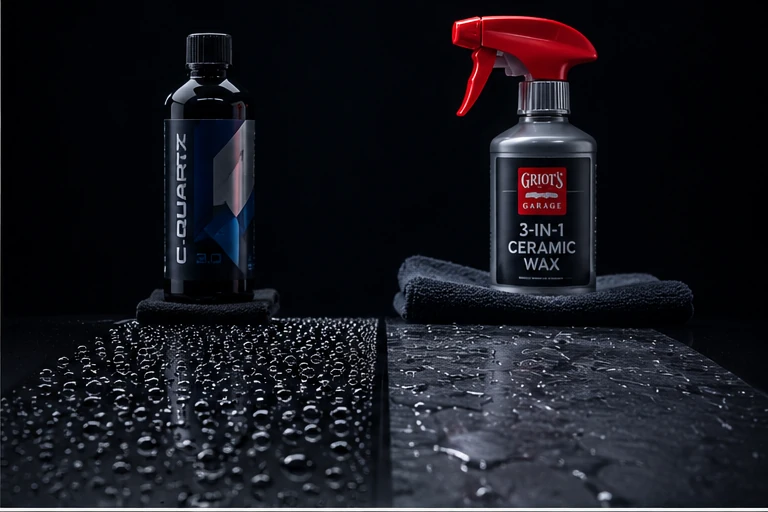
Ceramic sprays and sealants are faster, more affordable protection products that add gloss, slickness, and hydrophobic behaviour. Examples in this category include spray-style products such as Griot’s Garage 3-in-1 Ceramic Wax or a compatible SiO₂ sealant, depending on the goal and package.
These products are useful, but they should not be sold as the same thing as a professionally installed coating. They are excellent for short-term protection, maintenance, gloss boosts, and topping an existing coating, but they do not replace the durability and prep requirements of a true coating system.
Ceramic spray vs ceramic coating: quick comparison
| Category | Ceramic Spray / Sealant | True Ceramic Coating |
|---|---|---|
| Prep required | Wash and clean surface; decon helps | Full prep, decon, inspection, often polishing |
| Application | Fast spray/wipe application | Controlled panel-by-panel coating application |
| Durability | Shorter term; depends heavily on use | Longer term when installed and maintained properly |
| Cost | Lower | Higher because prep and labour are greater |
| Best use | Gloss boost, seasonal protection, topper | Long-term protection and easier maintenance |
SiO₂, polymers, resins, and toppers explained simply
SiO₂ is commonly associated with ceramic-style protection, but not every SiO₂ product behaves the same. Some products are true coatings that cure into a harder, more durable film. Others are spray sealants or toppers that add slickness and hydrophobic performance for a shorter period.
Polymers and resins can improve gloss, slickness, and water behaviour. Toppers are products used over a coating to refresh slickness or water beading. A topper can make a coating feel stronger, but it is not the same as reinstalling or replacing the coating underneath.
Durability expectations
Durability depends on product type, paint prep, vehicle use, washing habits, parking conditions, weather, road salt, and maintenance. A ceramic spray on a daily-driven GTA vehicle will not behave the same as a professional coating on a properly corrected and maintained vehicle.
Be cautious with exact durability claims. A product can be rated for a certain period in ideal conditions, but real life includes winter salt, automatic washes, improper towels, harsh chemicals, and long periods without maintenance.
Gloss, slickness, water beading, and hydrophobic behaviour
Both ceramic sprays and true coatings can improve water beading and slickness. A true coating can provide stronger long-term protection, but water behaviour alone does not prove that a coating is healthy or that the paint is fully protected.
Hydrophobic behaviour helps the vehicle clean easier and release water better, but it does not make the vehicle self-cleaning. Dirt, minerals, salt, and road film can still bond to the surface if the vehicle is neglected.
Chemical resistance and UV resistance
True coatings generally offer better resistance than basic sprays, especially when properly installed. That does not mean they are invincible. Strong chemicals, poor washing, environmental fallout, hard water, and neglect can still reduce performance or stain the surface.
Think of protection as a sacrificial layer that makes maintenance easier and helps preserve the finish. It is not armour against every type of damage.
Why paint preparation matters
Preparation is the difference between simply making paint shiny for a short time and properly protecting a clean surface. Decontamination removes bonded material that normal washing cannot. Polishing can improve gloss, clarity, haze, and swirls before protection is applied.
If a customer wants a coating mainly because the paint looks dull or swirled, paint correction may be needed first. Coating dull paint may make it easier to clean, but it will not automatically create the clarity of corrected paint.
What 9H hardness means and what it does not mean
9H hardness is one of the most misunderstood coating claims. It does not mean the paint is scratch-proof. It does not stop rock chips. It does not prevent damage from dirty wash mitts, automatic brush washes, or aggressive drying towels.
Hardness claims are usually based on controlled testing, not real-world immunity. A coating can add resistance and make maintenance easier, but careless washing can still mark the surface.
Can ceramic coating prevent scratches?
A ceramic coating can help with resistance to very light marring, but it should never be presented as scratch-proof protection. It does not stop deep scratches, key marks, rock chips, heavy abrasion, or poor wash technique.
If physical impact protection is the goal, paint protection film is the stronger category. If easier washing, gloss, chemical resistance, and hydrophobic behaviour are the goal, ceramic coating makes more sense.
When ceramic spray makes sense
Ceramic spray makes sense when the customer wants a noticeable gloss boost, water behaviour, slickness, and short-term protection without the cost or prep of a full coating. It is a good fit for maintained daily drivers, seasonal refreshes, and customers who want better protection than an unprotected wash.
It also works well as a maintenance topper for vehicles that already have ceramic protection, assuming the product is compatible with the coating and the vehicle has been washed safely first.
When a true ceramic coating makes sense
A true ceramic coating makes sense when the customer wants longer-term protection, easier maintenance, stronger hydrophobic behaviour, and a more serious preservation plan for the paint. It is especially worthwhile on new vehicles, premium vehicles, corrected paint, daily drivers the owner wants to maintain properly, and vehicles exposed to regular weather and road film.
The best coating results come from pairing the coating with proper prep and realistic maintenance expectations.
Maintenance differences
Ceramic sprays are easier to refresh more often. True coatings should be maintained with safe washing, pH-appropriate chemicals, periodic decontamination when needed, and compatible toppers when performance starts to decline.
Neither option survives careless washing forever. Automatic brush washes, dirty towels, harsh degreasers, and long-term neglect can reduce performance on both sprays and coatings.
Cost and value comparison
Ceramic spray offers strong value when the goal is affordable gloss and short-term protection. True ceramic coating costs more because the service includes surface preparation, controlled application, cure considerations, and usually a higher level of inspection.
The right choice depends on the vehicle, the owner’s expectations, the paint condition, and how the car will be maintained after the service.
The Auto Edit protection approach
At The Auto Edit, ceramic-style protection can be part of detail packages where it fits the service level. Griot’s Garage 3-in-1 Ceramic Wax may be used in spray-style protection contexts, Collinite 845 may be used for hand-applied wax protection, and an SiO₂ sealant may be used where appropriate.
True ceramic coating is treated as a separate service because it requires more serious preparation and expectation-setting. The Auto Edit uses System X for its named professional ceramic coating systems. The 2 Year Ceramic Coating uses System X Crystal+ as its dedicated professional coating.
Final recommendation
Choose ceramic spray or sealant if you want affordable gloss, slickness, water behaviour, and short-term protection. Choose a true ceramic coating if you want a more durable protection system and are willing to invest in proper prep and maintenance.
The most important thing is not the word “ceramic.” It is whether the surface was prepared properly, the product matches the goal, and the vehicle will be washed safely after protection is installed.