
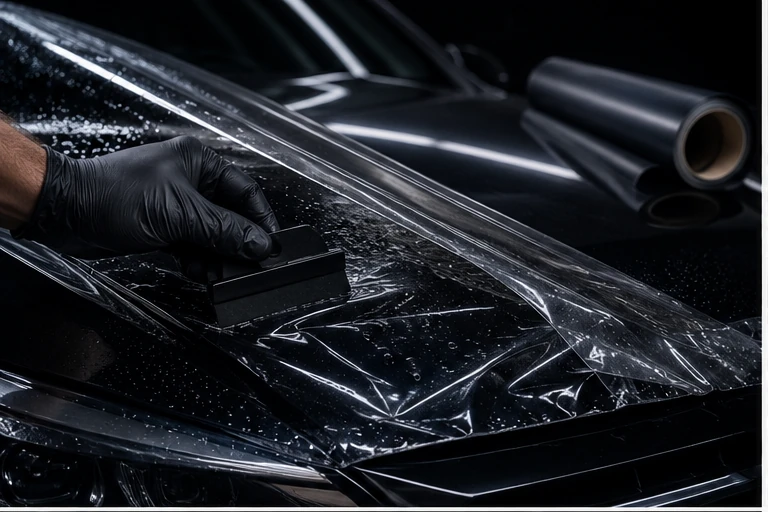
Film decisions depend heavily on paint condition and goals, so it helps to review how to prepare before an appointment, what correction can and cannot fix, and how film compares with ceramic protection.
What PPF is
PPF stands for paint protection film. It is a clear or finished film installed over painted panels to help protect the paint from road rash, stone chips, bug staining, light scuffs, and daily driving wear. The main purpose is protection, not changing the vehicle into a different colour.
Most customers choose PPF for high-impact areas: front bumper, hood, fenders, mirrors, headlights, rocker panels, door edges, and other panels that get hit by road debris. A full-body PPF job is for customers who want protection over nearly every painted exterior panel.
What vinyl wrap is
Vinyl wrap is mainly an appearance film. It changes the look of the vehicle with a new colour, finish, pattern, branding, or printed design. Vinyl can make a vehicle look satin black, gloss blue, matte grey, colour-shift, or completely custom without repainting the car.
Vinyl does offer a thin layer between the paint and the outside world, but it should not be sold as the same protection as PPF. Its job is style first. Protection is secondary and limited.
The main difference: protection vs appearance
The cleanest way to understand the difference is simple: PPF protects paint, vinyl changes appearance. If your goal is to reduce front-end chips and road rash, PPF is usually the better answer. If your goal is to make a white car look satin black or add a custom finish, vinyl wrap is usually the better answer.
| Goal | Better fit | Why |
|---|---|---|
| Protect front bumper and hood from road debris | PPF | Thicker protection film designed for impact resistance |
| Change vehicle colour or finish | Vinyl wrap | More finish and colour options |
| Protect a new premium vehicle while keeping factory paint visible | Clear PPF | Preserves the original paint appearance |
| Build a custom visual style | Vinyl wrap | Designed for appearance customization |
Clear, matte, satin, coloured PPF and vinyl options
Clear PPF is the most common option for customers who want protection without changing the vehicle’s colour. Matte and satin PPF can change the finish while still prioritizing protection. Coloured PPF is a newer-style option that can combine appearance change with stronger protection than standard vinyl in many cases.
Vinyl wrap is available in gloss, satin, matte, metallic, colour-shift, textured, printed, and custom finishes. That makes vinyl the more flexible option when the goal is visual transformation.
Thickness and material differences
PPF is generally thicker and more impact-focused than vinyl. That thickness is part of why it can absorb more road abuse, especially on front-end panels. Vinyl is generally thinner and more flexible for colour change, complex styling, and full-vehicle design work.
This is why the two films feel different in real use. PPF is built to take more punishment. Vinyl is built to create a new look.
Rock chips, scuffs and self-healing
Quality PPF can help reduce stone chips, road rash, bug staining, and light scuffs. Some films also have self-healing top coats that allow fine marks to relax with heat. Self-healing does not mean scratch-proof. It does not stop deep cuts, hard impacts, poor washing, or damage that goes through the film.
Vinyl wrap can reduce very light surface contact, but it is not designed to absorb impacts like PPF. A stone that would chip paint may still damage vinyl and can still mark the paint underneath depending on force, film quality, and installation.
UV exposure, fading and lifespan expectations
Both PPF and vinyl are affected by sun exposure, weather, washing habits, road salt, parking conditions, and product quality. PPF can help preserve factory paint underneath by shielding it from some environmental wear. Vinyl can change appearance beautifully, but colour and finish stability depend heavily on film quality and maintenance.
Do not treat any lifespan number as a guarantee. A garage-kept weekend car, a daily-driven GTA commuter, and a vehicle parked outside year-round will not age the same way.
Cost and value comparison
PPF often costs more than vinyl for the same coverage area because the material and installation requirements are protection-focused. The value comes from protecting paint, especially on newer, premium, leased, financed, or resale-sensitive vehicles.
Vinyl can deliver more visual change per dollar if the goal is style. The value comes from customization, branding, or changing the vehicle’s personality without repainting it.
Partial front, full front and full body PPF
The Auto Edit offers three direct-bookable PPF packages: Partial Front End PPF, Full Front End PPF, and Full Body PPF. Partial front coverage is usually for the highest-impact front areas. Full front coverage is a stronger option for customers who do highway driving or want the front of the car protected more completely. Full body PPF is for customers who want the highest protection approach across the vehicle.
Choose a PPF package and vehicle-size category, request a drop-off, and pay a 20% deposit through secure Square checkout. Vehicle fitment, paint condition, film selection, final install scope, production timing, and pickup timing are confirmed after review. Colour-change and custom vinyl wraps remain quote-only.
When vinyl wrap makes more sense
Vinyl wrap makes more sense when the customer wants a colour change, a matte/satin look, branding, graphics, or a temporary style change. It is also useful when the customer wants a specific look that paint correction, ceramic coating, or PPF cannot create.
Vinyl is not the best answer if the main concern is highway stone chips. For that, PPF is the stronger protection choice.
When PPF makes more sense
PPF makes more sense when the customer wants to preserve paint condition. It is especially valuable on new vehicles, high-value vehicles, dark paint, front ends that see highway mileage, performance cars, leased vehicles, and cars the owner wants to keep looking cleaner for longer.
If the vehicle already has beautiful factory paint and the owner wants to protect it, clear PPF is usually more aligned with the goal than vinyl wrap.
When combining PPF and vinyl makes sense
Some builds use both. A customer may choose vinyl for appearance and PPF on high-impact areas for extra protection. In other cases, coloured PPF may be a better fit because it combines a finish change with stronger protective characteristics than standard vinyl.
Compatibility matters. Layering film over film is not something to guess on. It depends on the material, finish, warranty expectations, installer recommendation, panel shape, and the customer’s budget.
What PPF and vinyl do not fix
Film does not repair bad paint. PPF and vinyl can hide some minor appearance issues depending on colour and finish, but they do not fix rock chips, failing clear coat, rust, dents, peeling paint, poor bodywork, or deep scratches. Those issues can show through film or create installation and removal risks.
If the paint is already compromised, the best first step is inspection. Sometimes correction, touch-up, bodywork, or a different service path is needed before film makes sense.
Paint condition, fresh paint and removal risk
Paint condition matters before any film installation. Fresh paint, repainted panels, old bodywork, failing clear coat, peeling edges, rust, rock chips, and weak paint can all affect how film installs and how safely it can be removed later.
Removal is not risk-free. Quality film and skilled installation help, but no honest shop should guarantee that every vehicle can be wrapped or unwrapped without risk. Repainted panels and failing clear coat need extra caution.
Maintenance differences
PPF and vinyl both need safe washing. Avoid aggressive brushes, harsh chemicals, abrasive towels, and pressure-washer misuse near edges. Matte and satin finishes need extra care because polishing or glossy products can change the finish appearance.
PPF is often chosen because it can take more driving abuse, but it still needs maintenance. Vinyl can look incredible, but poor washing, hard water, salt, sun, and neglect can shorten its life and damage the finish.
Why cheaper film or installation can cost more later
Film work is not just material. It is prep, panel cleaning, pattern fit, edge control, trimming discipline, contamination control, and installer judgement. Cheap film or rushed installation can lead to lifting edges, visible dirt, stretch marks, glue lines, poor alignment, knife marks, and difficult removal.
The best value is not always the lowest quote. The best value is the film and install approach that matches the vehicle, the customer’s goal, and the condition of the paint.
The Auto Edit recommendation
Choose PPF if your priority is protection. Choose vinyl wrap if your priority is changing the look. Consider both only when the build plan, budget, film compatibility, and paint condition support it.
For a daily-driven vehicle in Mississauga, Oakville, or the GTA, front-end PPF can make a lot of sense because of highway driving, salt, construction debris, and road rash. For a customer who wants a dramatic new style, vinyl wrap or coloured film options may make more sense after inspection.
Final PPF vs vinyl wrap checklist
- If you want protection first, look at PPF.
- If you want appearance change first, look at vinyl wrap.
- If you want both, ask about compatibility and budget before choosing.
- Inspect paint condition before film.
- Disclose fresh paint, repainted panels, old film, peeling clear, and bodywork.
- Do not expect film to fix damaged paint.
- Do not assume self-healing means scratch-proof.
- Choose film and installation quality carefully.